
Installation Begins for New Solar Training Facility in Berlin
Roll-On Solar PV Ready for its Time in the Sun
Flexible solar PV is now market-ready due to recent breakthroughs in efficiency, durability, and adhesives.
Communications
January 29, 2026
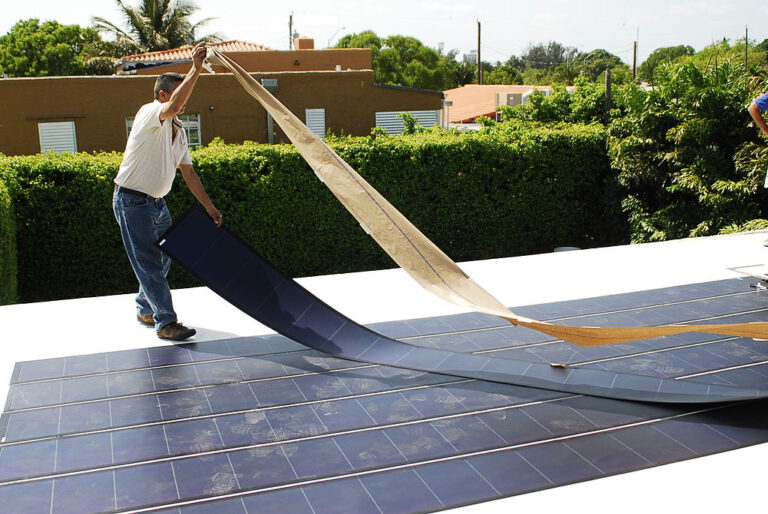
For several decades, solar energy capture has relied primarily on rigid silicon wafers encased in glass and aluminum frames. This design, while functional, presents limitations in specific applications. Some existing structures cannot support the static weight of traditional panels, and curved surfaces are generally incompatible with rigid modules. This created a demand for a lightweight, adaptable alternative that could be applied directly to surfaces without mechanical fasteners.
The development of thin-film technology began in the late 20th century. By the 1980s, amorphous silicon cells were integrated into small consumer electronics, such as calculators. However, scaling this for residential or industrial power proved difficult for two reasons: efficiency and durability. Early flexible modules produced less power per square meter than rigid silicon and often degraded within five to ten years due to moisture ingress and UV exposure.
Technical milestones achieved between 2024 and 2026 have addressed these primary barriers. The use of perovskite-silicon tandem cells has increased commercial efficiency ratings to the 24–28% range, which is comparable to current high-end rigid panels.
The commercialization of advanced encapsulation and adhesive chemistry throughout 2025 further stabilized the technology. This was achieved through the implementation of “self-healing” fluororesin coatings and specialized polymers that react to thermal or mechanical stress by resealing micro-cracks, preventing moisture from reaching the sensitive solar cells. Furthermore, the industry transitioned from standard glues to silicone-based nanocomposite adhesives. These compounds maintain chemical stability across a temperature range of -60°C to 200°C, preventing the degradation previously caused by prolonged UV exposure. Consequently, 2026 performance warranties from manufacturers such as Oxford PV and Seaforest now match those of rigid panels, with some modules certified to withstand wind speeds of 56 m/s and snow loads of 2 meters without adhesive failure.
Powering the Shift: Required Industry Skills
At greentech.training, we track how these technological shifts change the requirements for the energy workforce. The transition to flexible PV necessitates a specific set of technical skills across production, installation, and maintenance.
Manufacturing has shifted toward high-speed, precision printing environments. This requires personnel trained in roll-to-roll (R2R) processing and materials science. These roles involve managing vacuum deposition and ink formulations to ensure uniform layer thickness across flexible substrates. Quality control now focuses on laser scribing and electroluminescence testing to verify electrical continuity.
The installation process for roll-on PV requires technical knowledge of surface chemistry and substrate preparation. Technicians must identify compatible cleaning protocols for different building materials—such as bitumen, metal, or polycarbonate—to ensure long-term adhesive bonding. System design for these modules also requires calculating electrical output for non-traditional orientations. Unlike rigid arrays that are often fixed toward the equator (south-facing in the northern hemisphere or north-facing in the southern hemisphere), flexible panels are frequently applied to vertical facades or curved surfaces that receive varying degrees of solar irradiance throughout the day.
Maintenance protocols are also evolving. Operations and Maintenance (O&M) professionals now use AI-driven performance analytics and thermographic inspections to monitor the health of thin-film layers. These tools allow for the detection of “hot spots” or shading losses that may not be visible to the eye. This shift from mechanical repair to digital diagnostics is a core component of modern solar technician training.
Preparing the Future Workforce in Solar
As the solar industry adopts new PV technologies, having a technically proficient team is essential for maintaining a competitive edge in installation and maintenance. Companies looking to train their staff by working with a leader in green energy upskilling are invited to use our contact form to get in touch. We provide specialized training programs in collaboration with worldwide experts tailored to the latest advancements in thin-film and tandem solar technologies.
#SolarEnergy #GreenTech #RenewableEnergy #Innovation #ThinFilmSolar
Featured News
Category
Keep Updated to our News and Blog